Paper A showed that an escape sign draws only a watt or two but must keep its pictogram legible - in smoke, at a certified viewing distance - for the whole rated duration. Paper B closes the loop from optics to cells: how the recognition-distance and luminance rules set LED power, how that power sets the NiMH ampere-hour requirement, and how NiMH compares with NiCd and lithium for this most patient of battery duties.
The sizing chain starts at the corridor, not the cell. EN 1838 and ISO 3864/ISO 7010 tie a sign's effective recognition distance to the height of its pictogram: for an internally illuminated sign the recognition distance is roughly d = 200 h, where h is the pictogram height in metres. A sign meant to be recognised at 40 m therefore needs a 200 mm-class running-man panel, whose area sets how much LED flux is required to hold the standard's minimum luminance across the safety-coloured surface (EN 1838 requires any 5 percent area of the safety colour to reach at least 2 cd/m²) and its contrast against the white field (a white-to-colour luminance ratio bounded between roughly 5:1 and 10:1). Photometric design converts that luminance and panel area into LED watts, and LED watts times rated duration becomes the battery energy target. Working backwards - choose viewing distance, derive panel size and LED load, then size the cells - is the only order that guarantees the certified optical performance at end of discharge.
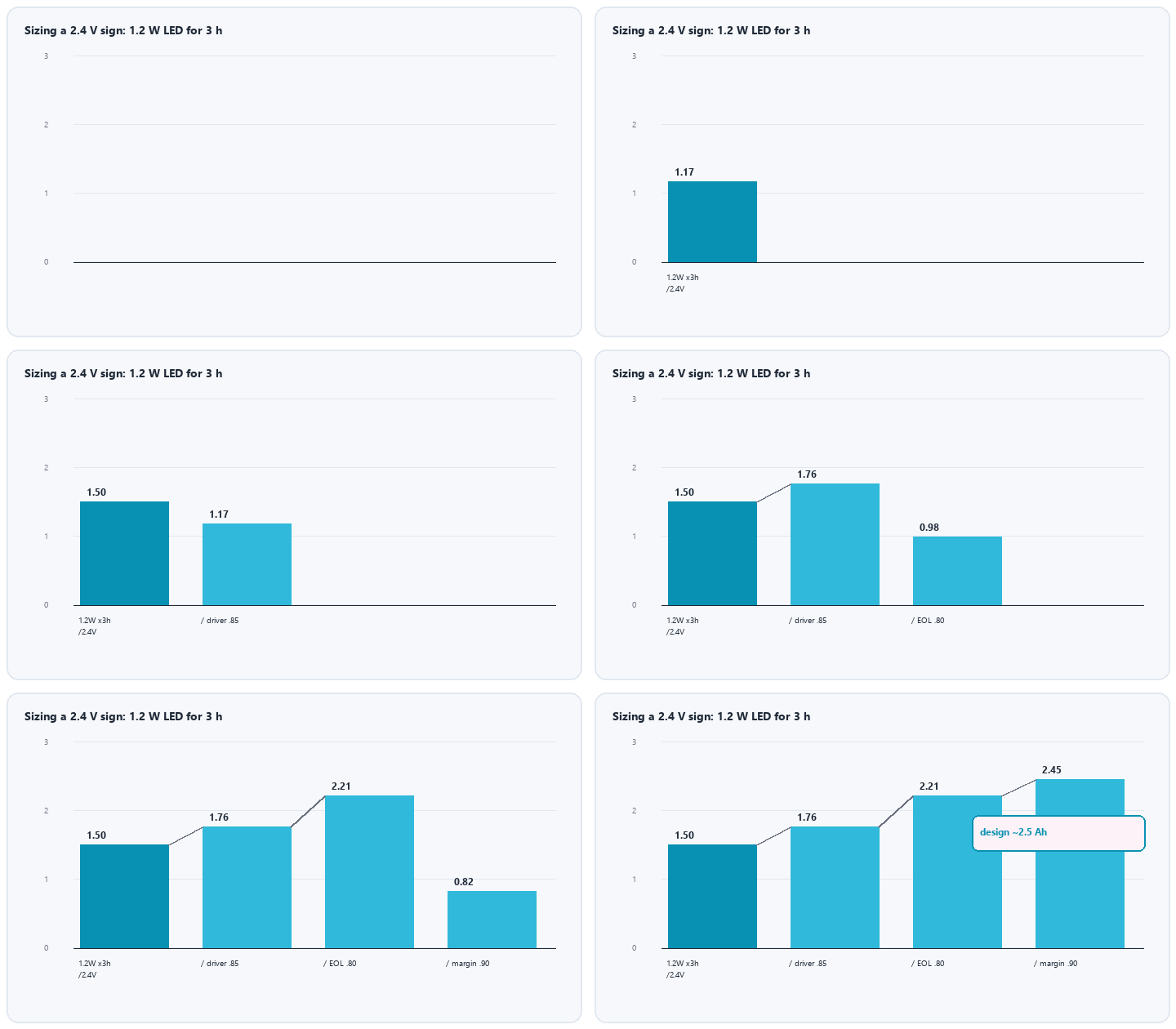
Once the LED load is fixed, the same derating discipline used across emergency lighting applies. Driver efficiency takes roughly 15 percent; end-of-life capacity retention at the four-to-five-year horizon takes 20 percent; a safety margin covers cold corridors and the extra draw of the status indicator and self-test circuitry; and the string must keep the driver above its dropout voltage at the end of the rated duration. The animated walk-through applies the chain for a representative 1.2 W, three-hour, 2.4 V sign; values are illustrative and a real design uses the measured driver curve. Because the load is so small, the resulting pack - of the order of 2.5 Ah at 2.4 V, two C cells or four AAs - fits easily inside a standard sign housing, which is why designers should spend the headroom on float-life margin rather than on minimising cell count.
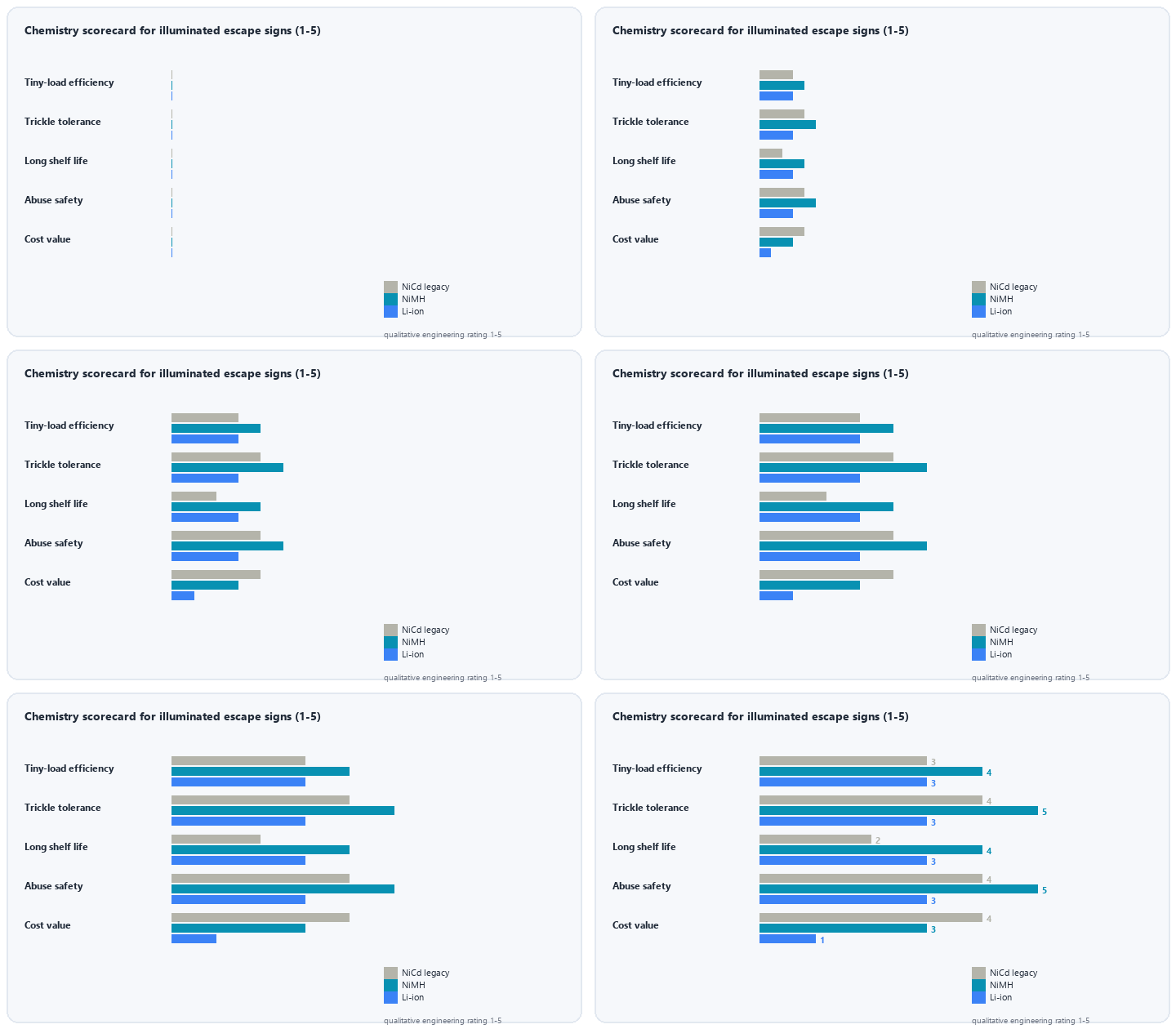
The sign battery's duty is float-dominated even more strongly than the emergency luminaire's: it may never experience a real discharge across its entire installed life, while monthly self-tests add only brief shallow cycles. NiCd tolerates this regime but carries cadmium under RoHS restriction and develops memory effect from the shallow test pattern; lithium adds management electronics and cost disproportionate to a 1 W load; NiMH brings cadmium-free materials, no memory effect, flat discharge voltage that keeps luminance constant across the rated event, intrinsic aqueous safety above an escape route, and low-self-discharge grades that remain ready after quiet months. The animated scorecard rates the chemistries on the five criteria that govern sign service; it is a qualitative engineering comparison.
Because EN 1838 compliance is judged on luminance, the electrical architecture must keep LED current constant as the battery discharges. A two-cell (2.4 V nominal) or four-cell (4.8 V) NiMH string feeds a constant-current LED driver whose dropout is chosen below the string's end-of-duration voltage; matched cells prevent one weak cell from pulling the string below dropout early. The charger follows the float rules for hot enclosures: temperature-compensated maintenance current, a bonded thermistor, and -dV/dt or timer-controlled recharge after the annual full test, returning to full within 24 h. Directional arrow variants, double-sided hanging signs and wall versus ceiling mounting change optical area but not the electrical method, so a common cell platform can cover a whole sign family with different LED module counts.
A sign housing lasts well beyond a battery, so a user-replaceable, keyed NiMH cartridge - marked with chemistry, capacity and manufacture date - extends certified life and aligns with the European battery regulation's removability expectations and with producer documentation duties. Nickel-based chemistry also keeps transport in the UN 3496 Class 9 category rather than lithium controls, simplifying delivery of replacement packs to installers across Europe. Paper C sets out the optical and electrical test programme that proves recognition distance, luminance contrast and duration together.
Weijiang Power builds matched NiMH strings and replaceable cartridges for illuminated escape signs across the 1-3 h duration ladder, with low-self-discharge grades, hot-enclosure float profiles and IEC 61951-2, IEC 62133-1 and UN 38.3 documentation. Send your panel size and LED load, required recognition distance, rated duration and ambient and we will size a pack that holds certified luminance and contrast to the end of the rated event at declared end of life.


